
Unpacking dark magic
Part 1: The things we know to be true (even when they aren’t)


Have you ever wondered why it’s so difficult to change people’s minds, no matter how persuasive you are? Beyond ego and cognitive dissonance, we all carry our deeply engrained “truths” about the world, though they seldom have anything to do with objective, unbiased truth. These are our Core Certainties—the pillars of our “reality.”
In my last postings What is the Cone Model Part 1 and Part 2, I provided an overview of the Cone Model I’ve developed in recent years, explaining how and why we keep building harmful systems that rob us of our freedoms and worsen our problems. In this installment, we will explore the nature of Core Certainties, their origins, and how they influence what we believe to be “our reality.”
There is a famous urban legend about a mother instructing her daughter on the best way to cook a pot roast:
Mother: “First, get yourself a nice brisket. Before you season it, cut and discard its two edges.”
Daughter: “Why cut the edges? What’s wrong with them?”
Mother: “That’s how grandma taught me to make it. I’m not sure why, but my pot roast always comes out great, right?”
Unsatisfied with her mother’s explanation, the daughter goes to her grandmother with the same question, only to receive the same answer. In a last act of inquiry, she asks her great-grandmother:
Great-grandmother: “Why cut the edges? Because back in my day we didn’t have large pots like you have today, so we had to make the brisket smaller to fit it into the pot.”
Save for natural disasters, not much in this world is as powerful as our Core Certainties—those things in which we thoughtlessly believe. Like a mighty tree, we are rooted in a rich soil made of all our perceptions, beliefs, values, personality traits, and experiences. Everything we think and do draws from this soil for us to make sense of ourselves, other people, and the world around us. We are all born into multiple social constructs that exist simply because we believe in them.
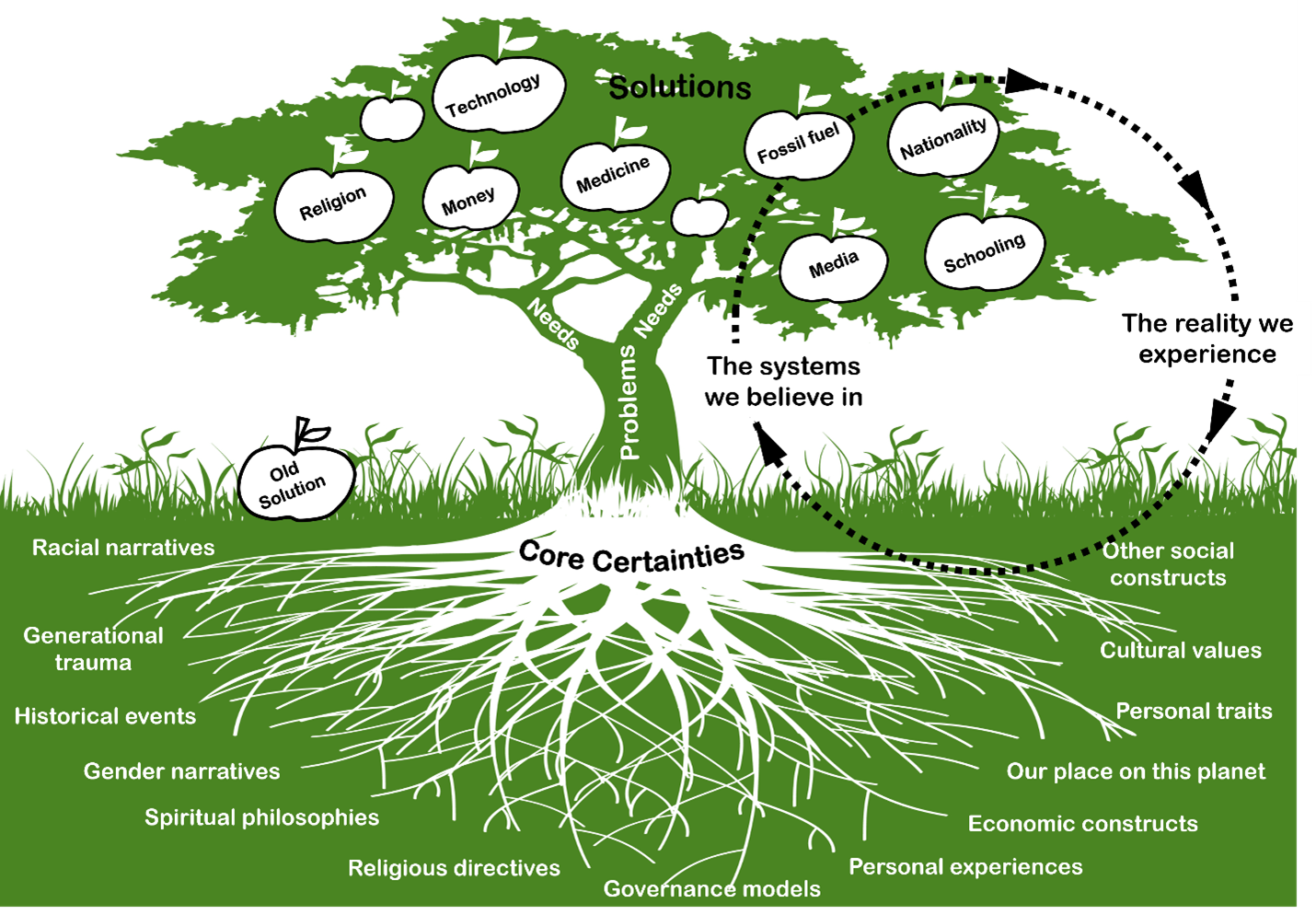
Almost anything you can think of that guides your actions and rules your life is based on constructs our societies have come up with and agreed upon: Countries, borders, and nationalities that separate people; regional and ethnic cultures that define “wrongs and rights”; money as the way to exchange goods and accumulate assets and power; racial differences that separate Us from Them; beauty standards that assign personal value; concepts of crimes and models of punishments; gender identities and gender roles; corporates as legal entities; marriage and family structure; and religions.
These and many others are all social constructs we came up with, and they only exist because we believe they do.
Our social constructs are based on historical events that shaped the lives of many generations and created shared stories, lessons, and trauma. This “soil” is further fertilized by our personal traits, childhood, and life experiences. It is the foundation upon which our joys, hopes, dreams, and difficulties grow, both as individuals and societies.
I coined the term Core Certainties instead of using “beliefs” to eliminate confusion around the potency of this state of mind. When we say, “I believe I should cut the edges off the brisket,” it may leave room for debate, as opposed to, “I am absolutely certain I must cut the edges off the brisket.” Our Core Certainties are far more potent than casual beliefs.
They are untouchable.
The many Core Certainties that create our reality guide the way we frame our Problems as one thing or another, leading to particular takes on our Needs and the Solutions we come up with. Using our pot roast example, if our Core Certainty is that there are only small pots in existence, we will consider an oversized brisket to be a Problem, which leads to a Need to reshape the slab of meat to fit into a small pot, which leads to a Solution of cutting the edges.
Beyond cooking principles, our Core Certainties shape the types of education our kids get, how we treat the natural world, how we define health and which healing methods we apply, the technologies we favour, the people we hate and discriminate, and the spiritual practices we uphold. Since our chosen Solutions will be based on our Core Certainties, they will act in a feedback loop, further strengthening our worldview. Solutions that we have abandoned, or that have evolved, will challenge, and eventually change our Core Certainties.
In the next article we will explore the sources of our Core Certainties and the hold these people and systems have on us.
If you want a deeper understanding of this dark magic, you are welcome to read my 5-time award winning book CONEtrolled: How we’ve lost out freedom and how to reclaim it.